William Holmes, 1779–1851
‘Black Billy’, the Tory whip who made party management a profession
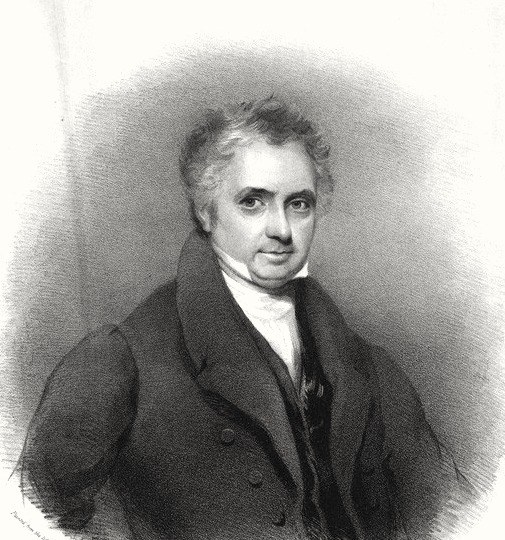
William Holmes was the Tory whip who made party management a profession. Earlier Treasury men had counted heads as one task among several; grandees had done it for a session and moved on. Holmes made it his working life, year after year. He did little else for more than a decade, through four governments. He counted the numbers, leaned on the waverers, traded favours for votes, and kept the majority together when it should not have held. He did it well enough that the job he made his own has been there ever since.
He was a brewer’s son from County Sligo who married money, bought his way into Parliament, and sat there for twenty-eight years without once making a speech worth the name. He held the salaried post of Treasurer of the Ordnance from 1818 until the fall of Wellington’s government, in practice the whip’s wage under another name. He was, at the same time, the paid London agent of Demerara, a slave colony, and worked for the plantation interest at Westminster until the year Parliament legislated for abolition. He proposed the move that founded the Carlton Club. Like the whips who came after him, he did much of his work out of sight, and a man who runs a party from behind the scenes for a decade leaves little behind him.
The nickname was Black Billy. It came from the black arts of the trade.
Holmes was my ancestor. I have spent my own life in politics too, on the opposite side from him, which is most of why I got curious. And there is a smaller coincidence: his career began in Trinidad, and years later a stretch of mine did too, though needless to say at very different work. None of it changes the facts below.
“Holmes, Sugden, and myself as men whom the Whigs would anxiously have kept out.”
The man in the record
Holmes survives mostly in other people’s books. A line in Creevey, two entries in the History of Parliament, a sarcastic dedication from a novelist who found him a good joke. Of his own papers, nothing has turned up. For the man who kept the Tory party in one piece through the worst of the Reform years, that is not much to go on.
Many who dealt with him did not like him. Hobhouse, a radical, called him “a notorious scoundrel”, and noted that Holmes described himself, at his own dinner table, as “a ministerial hack”. Few treated it as remarkable that, for much of his time as whip, he was also on the payroll of a slave colony.
OneA brewer’s son
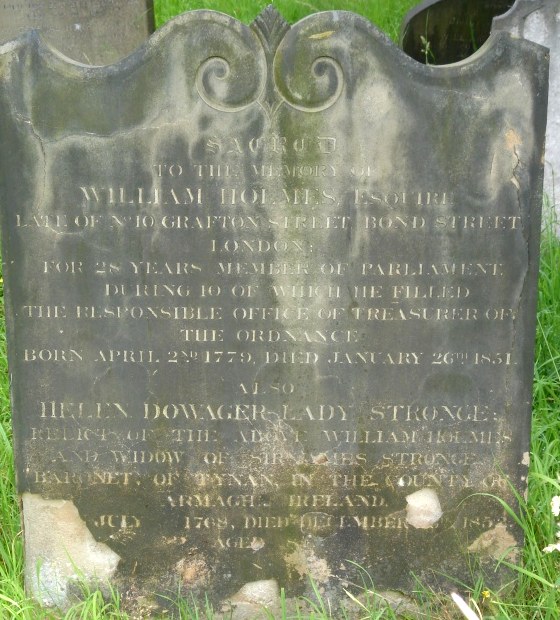
Holmes was born in County Sligo, fifth son of Thomas Holmes of Farmhill – the parliamentary record spells it Farnhill – a brewer who did well enough to serve as High Sheriff of the county. His mother was Anne Phibbs. This was trade money, not the landed Ascendancy the name might suggest. His headstone gives his birth as 2 April 1779; the parliamentary record prefers 1777, because he went up to Trinity College Dublin in April 1795 recorded as seventeen, which points a little earlier. The gravestone is followed here.
He was schooled under a Reverend James Armstrong, went up to Trinity in 1795, and left without a degree. Then the army, which is what a fifth son did when there was no land coming to him: lieutenant in the 4th Foot in 1799, the 69th the following year, and from 1803 a captain in the 3rd West India Regiment, out in the Caribbean as military secretary to Sir Thomas Hislop, governor of Trinidad. Four years there, 1803 to 1807. That was where he first got among the West Indian planters, and it marked the rest of his career.
TwoThe marriage that paid for it
He left the army in 1807 and married that October. Helen, Lady Stronge, was daughter and co-heiress of John Tew of Dublin and the widow of a baronet, the Reverend Sir James Stronge of Tynan in County Armagh. She was born in 1768, eleven years older than him, and she had money. He married, found he could afford to leave the army, and was in Parliament inside a year.
The marriage gave him a stepson, Sir James Stronge, the second baronet, and he wrote to him for the next forty years. Those letters, printed in a 1911 book called Next Door Neighbours, are as close as we get to his own voice, and most of what is known about his private life comes from them.
The same book carries a run of letters from a woman called Grace Tew, who has sometimes been taken for a first wife. She was not. Holmes married once, and Helen was born a Tew, so Grace was most likely her sister, living in the house. Her letters are the best record we have of the domestic side of him: who dined, who called, when Mr Holmes was “busy at the Carlton Club”. Her clothes caught fire at Grafton Street in the early 1830s and she nearly died of it, which Holmes reported to his stepson in one flat line: “She is now, however, quite well again. What an extraordinary person she is.”
One son came of the marriage, Thomas Knox Holmes, born in 1808.
ThreeSix seats, and almost nothing said
Holmes first stood for Parliament in March 1808 at Grampound in Cornwall, on Basil Cochrane’s money. He lost the poll and got the seat on petition. Grampound was one of the rottenest boroughs in the country, ultimately abolished for corruption. His fellow member there, Andrew Cochrane-Johnstone, was thrown out of the House in 1814 over the Great Stock Exchange Fraud and fled to the West Indies, where he set up a plantation in Demerara. Colonial money and sharp practice were the water Holmes swam in from the start.
He never had to win a seat in a real contest. Over twenty-eight years he passed through six of them, nearly all in the same way: Grampound to 1812, then Tregony, then Totnes from 1818, then Bishop’s Castle from 1820, then Haslemere from 1830, and finally Berwick-upon-Tweed from 1837 to 1841. Every one before Berwick was a pocket borough or close to it – a seat in the gift of a patron, handed to whoever the patron favoured, with barely a voter in sight.
Queenborough, in 1830, shows how he worked. He was put up there as a government candidate against Thomas Gladstone – son of the Liverpool slave-owner John Gladstone, and elder brother of the future prime minister – and both sides claimed the seat. The result was petitioned at once for “gross and notorious bribery”. When Wellington’s government fell that November and Holmes lost the office whose patronage had carried the seat, he declined to fight the case and quietly took Haslemere instead, where he had also been returned.
He did not fight a genuinely open contest until he was nearly sixty. When he tried, at a Berwick by-election in 1835, he pulled out, writing that the ground was so well held that his only hope of winning lay in “means that might (if I had succeeded) have also sent me to Newgate”. Two years on he took Berwick anyway, for about £1,200, some of it raised by subscription; Peel chipped in fifty pounds.
People say he spoke once in all his years in the House. Hansard has four, all in 1818 and 1819, none of them a speech in any real sense. The first, on 3 April 1818, was a motion for leave to bring in a bill letting enslaved people be moved from one colony to another, Demerara chiefly in view. The last, early in 1819, was a procedural note about a Mr Wyndham Quin. After that, more than twenty years of silence on the floor. His work happened elsewhere.
FourThe Ordnance and Demerara
The paid post came in 1818. It is on his gravestone: twenty-eight years an MP, “during 10 of which he filled the responsible Office of Treasurer of The Ordnance”. He held it from June 1818 until Wellington’s government fell in November 1830, formally giving way in early 1831 to the Whig diarist Thomas Creevey. The place had come vacant, Lord Mulgrave was told only that “a Member of the House was wanted for the post”, and Holmes was put in. Twelve hundred a year, and no other Treasury tie of any kind. In plain terms it was the whip’s salary paid out of public money for work the state would not name. The arrangement outlived him. To this day the government chief whip is styled Parliamentary Secretary to the Treasury, draws a Treasury salary and has no Treasury policy brief.
Demerara is the darker appointment. By 1820 Holmes had taken on the work of London agent for the colony, and he kept it until 1833, the year Parliament passed the Slavery Abolition Act. A colonial agent was the planters’ paid man at Westminster, there to slow the abolitionists down and protect what the plantations had. Demerara was among the most lucrative of the British plantation colonies, and its slave system was notoriously brutal. Holmes’s own first motion in the Commons, back in April 1818, had been about shipping enslaved people into it, and the agency grew out of work like that. He owned property in Demerara himself. For more than a decade he served as the government’s whip and drew a second wage from a slave colony, and there is no sign it troubled him.
He believed it as well as banked it. In the summer of 1833, days after Parliament passed the abolition legislation, he wrote to his stepson:
“Parliament will be prorogued this week, and a more important Session never sat. God grant that what has been done may not bring down utter ruin on the different interests they have legislated, but I cannot help thinking that the fate of the West Indies is for ever sealed, as I know the negroes will not work when free.”
The favours ran through his own family too. A place in Jamaica worth £2,400 a year went to a brother in 1811; the collectorship of Sligo went to his brother Richard in 1815. When four aristocratic backbenchers sent round a note grumbling that he whipped them too hard, Holmes wanted it sent back with a list of what their own families had drawn from the public purse. Someone talked him out of it.
FiveThe great calculator
From 1818 Holmes was the Treasury whip, and by 1820 simply the chief whip, through Liverpool, Canning, Goderich and Wellington. No title, no office that admitted what he did. Henry Bankes called him, in 1819, “our great calculator upon relative numbers”. Another man who watched him work said he “seemed to know every collateral relationship in blood and politics” of every member he had to bring into the lobby. He carried the debts, the family ties and the weak spots of the whole government benches in his head, and he traded appointments and church livings and colonial places for votes. In one bad week he complained that twenty-two members had written to him in a single morning, all begging to be paired off so they could go home.
Nobody warmed to him. Lord Binning called him “that Irish rascal Black Holmes”, and it stuck. The men who sneered could not run a session without him.
On the Catholic question his votes and his private mind went different ways. An Irish Protestant of the brewing class, he voted against Catholic relief in 1827 and again in 1828. Then he told Lord Powis, the patron who controlled his seat, that a settlement had to come anyway, “as things cannot rest where they now are, and we Protestants are clean beat after a fair stand-up fight in the Commons”. A year later, when Wellington judged that refusing Catholic Emancipation risked civil war in Ireland, Holmes turned round and whipped the Protestant votes that carried the Roman Catholic Relief Act of 1829. The government came first, ahead of anything he actually thought.
SixParkside, 15 September 1830
Holmes had a knack for being close to catastrophe. He had been standing beside Prime Minister Spencer Perceval in the Commons lobby in 1812 when Perceval was shot dead, the only British prime minister ever assassinated. Eighteen years later he was in Wellington’s party at the opening of the Liverpool and Manchester Railway. At Parkside, a stop on the line near Newton-le-Willows, the engines halted for water and the guests stepped down onto the track. It was Holmes who called William Huskisson across to the Duke’s carriage; the two had fallen out, and Holmes seems to have wanted to broker a handshake. While they stood there, Stephenson’s Rocket – the most famous locomotive of the age – came down the parallel line.
Holmes pressed himself flat against the carriage, gripped the rail, and shouted at Huskisson to hold still. Huskisson lost his head, grabbed at the carriage door, and it swung him into the engine. It took his leg, and he died that night: the first widely reported railway passenger death. Creevey had it that “Billy Holmes and Birch stuck fast to its side, and the engine did not touch them.”
Six days later Holmes wrote home:
“Poor Huskisson was killed by my side, in consequence of his losing his presence of mind, which, thank God, adhered to me, and saved my life; I drew myself into the smallest compass I could, and held fast on the iron railing of our machine, and, in that situation, and within grasp of Huskisson, I dare not stretch out my hand to save him, or do more than to tell him to do as I did. . . . He did not attend to my advice.”
Little grief reaches the page. A man had died within arm’s reach of him, and the letter is mostly about how well Holmes kept his own nerve. He watched it the way he watched everything in that House – who kept their head, who lost it.
SevenReform
The Reform crisis of 1831–32 – the great fight over widening the vote and sweeping away the rotten boroughs – was the battle of his career, and he was on the losing side. He voted against the bill in December 1831, when the opposition could only scrape 162 against 324. All that winter he fed Peel intelligence on the government’s manoeuvres over the King and the threatened creation of peers. His source was Edward Ellice, the Whig whip. The two men paid to fight each other swapped notes like the colleagues they really were.
When Grey resigned in May 1832 and the King turned to Wellington, Holmes was in the thick of the failed scramble to build a government. His letters to his stepson from that fortnight are the frankest thing he ever put down. On 15 May he explained why it had fallen apart – Peel and the rest were too openly against reform to be the ones to carry it – and then let this slip:
“I have had my own trouble, and more than my share, in these transactions, in which I have been treated with the greatest confidence by all parties, and had the Duke formed his Government, there was nothing I thought myself fit for I might not have obtained.”
A week later, the count:
“I have worked hard for the last eighteen months, and kept our little band together. We only commanded 260 on the last division on Reform; we voted 241 – thirteen paired off during the night, and six were too ill to attend; and though always in a minority and opposed to the Government, we never had a deserter. I am certain that other times will duly appreciate our consistency.”
Not one deserter. And the line he held so well was in defence of the pocket boroughs that had handed him every seat he ever sat in – so the discipline was self-interest as much as principle. It was still discipline, and there was no one else who could do it.
One thing came out of the wreck and outlived him. Through 1831 the opposition had been working out of cramped rooms in Charles Street, and it was chiefly at Holmes’s suggestion – the phrase is the History of Parliament’s – that the party took a bigger house and turned it into a club. That became the Carlton Club. The whip who spent his life defending the rotten boroughs helped give his party one of the institutions that let it survive their loss.
EightOut in the cold
Reform abolished Haslemere, and his seat with it. In November 1832 he wrote to Peel that he had given up on getting back – he could not fund a contest – but that whatever a man outside the House could do for the party was “constantly at your command”. Peel barely answered. The election management Holmes had run for years went to Francis Bonham, who saw that the reformed electorate needed registration and legal organisation rather than backroom deals. Hardinge thought Holmes ought to be found a seat for his services. None was found.
There was a grubbier loose end. A man named John McEntaggart, who had done confidential work for the party’s election committee at Charles Street, spent the latter part of 1832 threatening to expose the party’s secret payments unless he was paid. Holmes had handled the money, so Holmes was the man he threatened, and Holmes made himself impossible to find until the business was smoothed over in February 1833.
He pulled out of Berwick in 1835, lost at Ipswich a month later, and got back into the House at Berwick in 1837. The whip’s job was going spare – Clerk, Ross and Bonham had all lost their seats – and Holmes was the obvious, experienced man to take it back. He did not get it. Senior Conservatives moved at once to warn Peel, who the History of Parliament dryly says “probably needed no telling”, that giving it back to Holmes would be unacceptable to the whole party bar the Lowther set. The respectable post-Reform party did not want Black Billy anywhere the public could see him. He sat out his last Parliament on the back benches and lost the seat in 1841, at sixty-two.
NineNo. 10 Grafton Street
Holmes came into real money in the mid-1820s. The story is that he won £21,000 in a lottery, dated by the family memoir to 1827, though the last state lottery was drawn in October 1826, so the win probably came then. About £3,000 went on the lease of No. 10 Grafton Street in Mayfair, £1,200 on Vine Cottage by the river at Fulham, and the rest was invested. On £1,200 a year, that bought him independence.
Grafton Street turned into a political house of the first rank. Wellington dined there again and again, the most abstemious man at the table, the memoir says, no drink, living on vegetables and chicken. The guests were the Tory establishment and its hangers-on: the lord chancellor Lyndhurst; the Duke of Cumberland, the king’s reactionary brother; the dandy Count D’Orsay; and the earls of Powis, Lonsdale and Chesterfield. The actor Edmund Kean performed scenes in the drawing room, the soprano Catalani sang, and in the 1830s Chopin played the piano at No. 10. Next door at No. 9 lived the Calverts, Whigs to the bone – Mrs Calvert was a daughter of the Speaker of the Irish Parliament – and the two households stayed close friends for decades. It is her diary, tucked into the memoir, that saved most of this.
Vine Cottage he later let to Lord Melbourne – a Whig prime minister paying rent to the Tory whip.
His reach ran a good way past Westminster. In September 1834 he turned up at the Prussian military review at Potsdam, dressed, by Grace Tew’s account, by “the Duke” in a Prussian uniform and up on a charger, thrilled with the whole thing, “all places open to him, and nothing to pay”. The Duke was almost certainly Cumberland, soon to be King of Hanover and the most feared of the King’s brothers. Yet at home he was oddly austere for that company: half a glass of sherry was too much for him, Grace said, and a stay at Wellington’s Strathfieldsaye had “cured my rage for play”. “Rage” was his word. The gambling had plainly been serious at some point.
TenIreland
Holmes was Irish, and Ireland runs through the letters, always from the Unionist side. Daniel O’Connell, the Catholic champion who led the campaign for Irish rights, was to Holmes “a curse to Ireland”; in 1841 he wanted the new Lord Chancellor to “watch him well, and pull him whenever he gives him a fair opportunity”; by 1845 he was following the row between O’Connell and the Archbishop of Dublin with something like glee.
On the land itself, though, he could be sharp. Writing from Downham Hall in 1843, he reckoned the great proprietors fair enough to their tenants and put the ruin of the country on the middlemen – the go-betweens who leased land wholesale and rack-rented it out in scraps. He guessed that Lord Devon, his own choice to run the government inquiry, would find the same racket on his own estates in Limerick and Clare. He could see the machinery of Irish poverty plainly enough. What he would never grant, anywhere in the letters, was that the Irish had any business fixing it themselves.
ElevenThe last years
Out of office, the habits stayed put. The letters of the 1840s are a whip’s letters with nobody left to whip. London “emptier than I ever knew it”. The O’Connell split tracked division by division. He heard a rumour that the Tsar had died and checked it in person with Baron Brunow, the Russian ambassador, who did not believe it. In January 1845 he reported a week at Drayton with Peel, in good spirits, expecting no trouble in the coming session. Within eighteen months the Corn Laws had split Peel’s government and the party Holmes had spent his life holding together. Whether he saw it coming, the letters do not say.
He died at Grafton Street on 26 January 1851 and was buried at Brompton Cemetery. The stone gives what he wanted remembered: twenty-eight years an MP, ten of them Treasurer of the Ordnance. Not a word about the whipping, which was the real work of his life. Helen outlived him by under two years, dying at Chelsea in December 1852, and lies with him.
The Annual Register gave him an obituary that opened “In the high and palmy days of Toryism…” and dwelt on his peculiar gifts. Years before, the novelist John Galt had dedicated The Member, a satire on the unreformed system, to Holmes, in mock tribute to his talent for handing out patronage. The Gauci lithograph at the head of this page dates from 1834, when Holmes was near the height of his influence.
TwelveThe son, Thomas Knox Holmes
His one son ran the other way entirely. Thomas Knox Holmes took everything his father kept buttoned down and lived it in the open. Born at Chichester in December 1808, he did forty years with the Buckinghamshire Yeomanry and made major. He got into Crockford’s, the great gambling den, on Lord Chesterfield’s word, and his father – the reformed gambler – wrote back that he was “very glad you got into Crockfords”. He kept operatic company, and when the tenor Mario fell ill one night at Covent Garden, Tom is supposed to have stood up in the stalls and sung the part.
Mostly he was a man who could not sit still. He rowed from Temple Stairs to Southend and back inside a day, won a rowing cup at sixty-nine, raced tricycles on the Brighton road at seventy-six, and was still cycling round London into his eighties.
The family always said that as a boy of seven he carried the first news of Waterloo – Napoleon’s defeat in 1815 – to the government. The corrected version is better. The boy was carrying a message for the banker Nathan Rothschild, whose couriers had beaten the government’s own. It was taken ahead to the Thatched House Tavern: “We have won a great victory in the Netherlands” – the first the assembled politicians heard of Napoleon’s defeat. Whatever Waterloo papers the family later kept came from that link to Rothschild’s couriers, not from any official errand.
He died in 1893, at Manchester. Sir John Astley’s memoir has the manner of it: he gave chase to a gang of youths who had jeered at him when his tricycle got into trouble, singing “He won’t go home till morning” at him, and his heart gave out in the chase. Astley’s crack about the “two she-bears” being off duty that afternoon is a nod to the prophet Elisha, whose mockers were mauled by bears on the spot. Tom got away.
ThirteenThe record
Twenty-eight years in the Commons, more than a decade of them as the Tory whip, the Ordnance salary and the Demerara agency running alongside. And at the end of it a party that had grown too respectable to be seen with him. He left almost nothing in debate, and no archive of his own has ever surfaced.
The record leaves no clean figure. The bought seats, the sinecure, the wages from a slave colony, the places found for his brothers, that line about men who “will not work when free” – none of it goes away. And yet he was good at the work: trusted by men who could not stand him, and blunt about the grubby trade his grander colleagues used and would not own. Galt put him in a novel. Disraeli named him to his sister. His own party, once it had made itself respectable, kept him from the whip’s office in 1837. Someone had to do the work he did, and it was never going to be the men whose names ended up on the statues.
A good deal is still missing. His early life is nearly blank, there is no will, no estate papers, and the Demerara accounts have never surfaced. Grace Tew’s place in the household is unconfirmed. If anyone can fill those gaps, I would be glad to hear.
Sources
The domestic side comes from E. M. Richardson’s Next Door Neighbours (1911), built out of the Calvert and Stronge family papers – rich, and not always reliable, so checked against the public record where possible. The political career rests on the two History of Parliament biographies (1790–1820 and 1820–1832), which are the source of most of the harder facts here, including the Queenborough return, the Demerara property and agency, and the Ordnance dates; on Historic Hansard for his four appearances on the floor; and on the headstone transcription at Brompton. Michael Taylor’s work on the West India interest in Parliament sets the Demerara agency in context. Creevey and Greville, Disraeli’s letters, Galt’s dedication and the Annual Register obituary of 1851 supply the colour, with Sir John Astley’s Fifty Years of My Life for the son. Turtle Bunbury’s history of the Stronges sorted out the marriage. There is a short Wikipedia entry as well.
The sources disagree on his birth year and the date of the lottery win. Where they do, I have left the disagreement in rather than settle it.